

Deploying Generative AI Safely Behind Enterprise Firewalls
A complete structural blueprint for deploying private large language models and vector search databases without exposing confidential IP.
A complete structural blueprint for deploying private large language models and vector search databases without exposing confidential IP.
Core Concepts
Deploying Generative AI Safely Behind Enterprise Firewalls
Generative AI holds the promise of automating massive workflows, from customer service to internal knowledge discovery. However, for enterprise organizations, public APIs present a significant security vulnerability: submitting proprietary code, draft financial portfolios, or customer service logs to external servers risks intellectual property leaks and compliance fines.
To harness Generative AI safely, enterprises must deploy models within their own virtual firewalls. Here is the architectural blueprint for secure enterprise deployment.
Step 1: Secure Private Model Hosting
Instead of sending data to external endpoints, you host open-weights foundational models inside your private cloud environment with restricted network access.
- Virtual Private Cloud (VPC): Restrict internet ingress and egress. The model container should have zero connection to the public web.
- Dedicated Hardware Clusters: Deploy on scalable GPU nodes managed with container orchestration.
Step 2: Retrieve-Augmented Generation (RAG) Architecture
Foundational models have no knowledge of your private files. Instead of expensive fine-tuning, implement RAG to feed context to the model dynamically during queries.
- 1Ingestion: Automatically ingest company PDFs, wikis, and databases.
- 2Vectorization: Run documents through an embedding model to create vector representations.
- 3Vector Store: Save embeddings in a private vector database located within the VPC.
- 4Query Loop: When a user queries the AI, search the vector database for the most relevant documents, append them as context, and send the request to the private LLM.
Step 3: Governance and Guardrails
Even behind a firewall, models need governance. Integrate an inspection layer:
- Prompt Sanitizers: Check inputs to block prompt injection attacks.
- PII Masking: Programmatically redact names and credit card details before they reach the model.
- Audit Logging: Record all AI interactions in a secure, immutable log file for monthly compliance reviews.
By deploying this private structure, DataParametrics helps enterprises achieve sub-second model response times, protect their proprietary trade secrets, and meet compliance metrics.
Strategic Outlook
Organizations that treat data as a product consistently outperform those that treat it as a byproduct.
— DataParametrics Research Practice
Architecture Comparison
| Feature | Centralized | Decentralized | Hybrid |
|---|---|---|---|
| Governance | Unified | Domain | Federated |
| Scalability | Moderate | High | High |
| Cost Control | Low | Complex | Balanced |
| Latency | Low | Variable | Low |
| Compliance | Simple | Distributed | Policy-as-code |
Core Principles
Privacy by Design
Compliance built into architecture, not added post-launch.
Performance First
Sub-second query engines with elastic auto-scaling clusters.
Data Sovereignty
Full control over data residency, access, and retention.
Discovery Audit
Inventory all databases, classify workloads, and map existing pipelines.
Architecture Design
Define schema standards, network topology, and governance policies.
Engineering Build
Develop secure pipelines, deploy infrastructure, integrate controls.
Quality Verification
Run automated data quality checks and performance benchmarks.
Production Release
Cut-over with zero downtime, monitor, and decommission legacy systems.
Strategic Recommendation
For mid-market enterprises, a hybrid architectural approach consistently delivers the highest ROI within the first 18 months of deployment.
Combine a physical data lakehouse backbone with domain-driven governance boundaries. Standardize metric definitions in a semantic layer to ensure alignment across all business units.
Key Takeaways
Treat data as a product with clear ownership boundaries and quality SLAs.
Combine physical lakehouse storage with domain-driven governance for optimal results.
Privacy engineering must be embedded at the architecture layer, not retrofitted.
Automate compliance monitoring with policy-as-code to reduce manual overhead.
Use a semantic layer to standardize metric definitions across all business units.
Continue Reading
Related Research
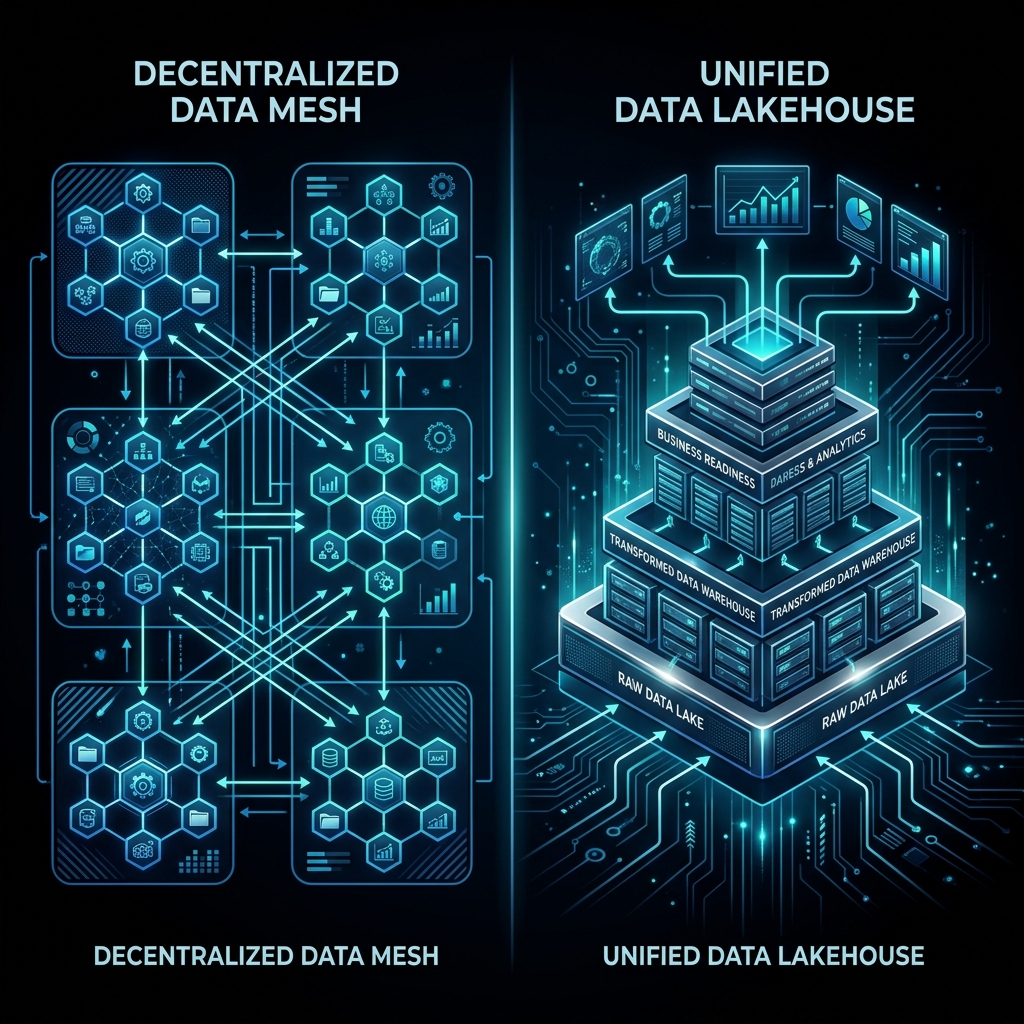
The Future of Enterprise Data Warehousing: Mesh vs. Lakehouse
An analytical deep dive comparing decentralized Data Mesh paradigms with centralized Unified Data Lakehouses, outlining key trade-offs for scaling teams.

Privacy-First Analytics: Engineering for Modern Data Protection
How modern analytics teams can capture customer usage trends and product metrics while maintaining strict compliance with evolving privacy rules.

Modern Lakehouse Architectures for Enterprise Scale
An architectural analysis of modern Lakehouse deployments, data product design, governance frameworks, and scalability considerations for global organizations.