

Privacy-First Analytics: Engineering for Modern Data Protection
How modern analytics teams can capture customer usage trends and product metrics while maintaining strict compliance with evolving privacy rules.
How modern analytics teams can capture customer usage trends and product metrics while maintaining strict compliance with evolving privacy rules.
Core Concepts
Privacy-First Analytics: Engineering for Modern Data Protection
Privacy is no longer just a legal checklist; it is a core feature of high-quality software. With evolving data protection requirements across jurisdictions, organizations face significant risk from careless tracking and poor data handling.
Yet, product and sales teams still need analytics to function. How do you balance data collection with user privacy? The answer is Privacy Engineering.
1. Zero-Trust Telemetry: Cookie-less Tracking
Traditional analytics relied on persistent cookies tracking users across the web. In 2026, cookies are declining. Privacy-first tracking uses:
- Transient Session Hashes: Instead of storing a permanent user ID, generate a cryptographic hash of the user's IP, User-Agent, and a daily rotating salt. This lets you track user pathing for 24 hours without storing any permanent identity records.
- Server-Side Tracking: Collect event data on your own servers rather than loading untrusted third-party JavaScript scripts directly into the user's browser.
2. Dynamic Data Masking & Tokenization
Personally Identifiable Information (PII) should never live in clear text in analytical warehouses.
- Dynamic Masking: Mask data based on user clearance levels (e.g., a customer support agent sees a phone number as
--1234, while an automated analytics script only sees a hashed representation). - Tokenization APIs: Route incoming PII through an isolated vault system that returns a random token. Save only the token in your warehouse. The real name/email is stored in an encrypted vault with strict audit controls.
3. Automated Subject Access Requests (SARs)
Under modern data protection laws, users have the right to request a copy of their data or demand that it be deleted. Handling these requests manually is costly and prone to error.
- SAR Orchestration: Build automated pipelines that query all databases and file servers using a unique user ID, zip the data, encrypt it, and send a download link to the user.
- Cascading Deletes: Ensure that trigger events automatically delete related database rows in primary, secondary, and backup storage locations.
Implementing these practices protects your enterprise from legal risks and demonstrates your commitment to customer trust.
Strategic Outlook
Organizations that treat data as a product consistently outperform those that treat it as a byproduct.
— DataParametrics Research Practice
Architecture Comparison
| Feature | Centralized | Decentralized | Hybrid |
|---|---|---|---|
| Governance | Unified | Domain | Federated |
| Scalability | Moderate | High | High |
| Cost Control | Low | Complex | Balanced |
| Latency | Low | Variable | Low |
| Compliance | Simple | Distributed | Policy-as-code |
Core Principles
Privacy by Design
Compliance built into architecture, not added post-launch.
Performance First
Sub-second query engines with elastic auto-scaling clusters.
Data Sovereignty
Full control over data residency, access, and retention.
Discovery Audit
Inventory all databases, classify workloads, and map existing pipelines.
Architecture Design
Define schema standards, network topology, and governance policies.
Engineering Build
Develop secure pipelines, deploy infrastructure, integrate controls.
Quality Verification
Run automated data quality checks and performance benchmarks.
Production Release
Cut-over with zero downtime, monitor, and decommission legacy systems.
Strategic Recommendation
For mid-market enterprises, a hybrid architectural approach consistently delivers the highest ROI within the first 18 months of deployment.
Combine a physical data lakehouse backbone with domain-driven governance boundaries. Standardize metric definitions in a semantic layer to ensure alignment across all business units.
Key Takeaways
Treat data as a product with clear ownership boundaries and quality SLAs.
Combine physical lakehouse storage with domain-driven governance for optimal results.
Privacy engineering must be embedded at the architecture layer, not retrofitted.
Automate compliance monitoring with policy-as-code to reduce manual overhead.
Use a semantic layer to standardize metric definitions across all business units.
Continue Reading
Related Research
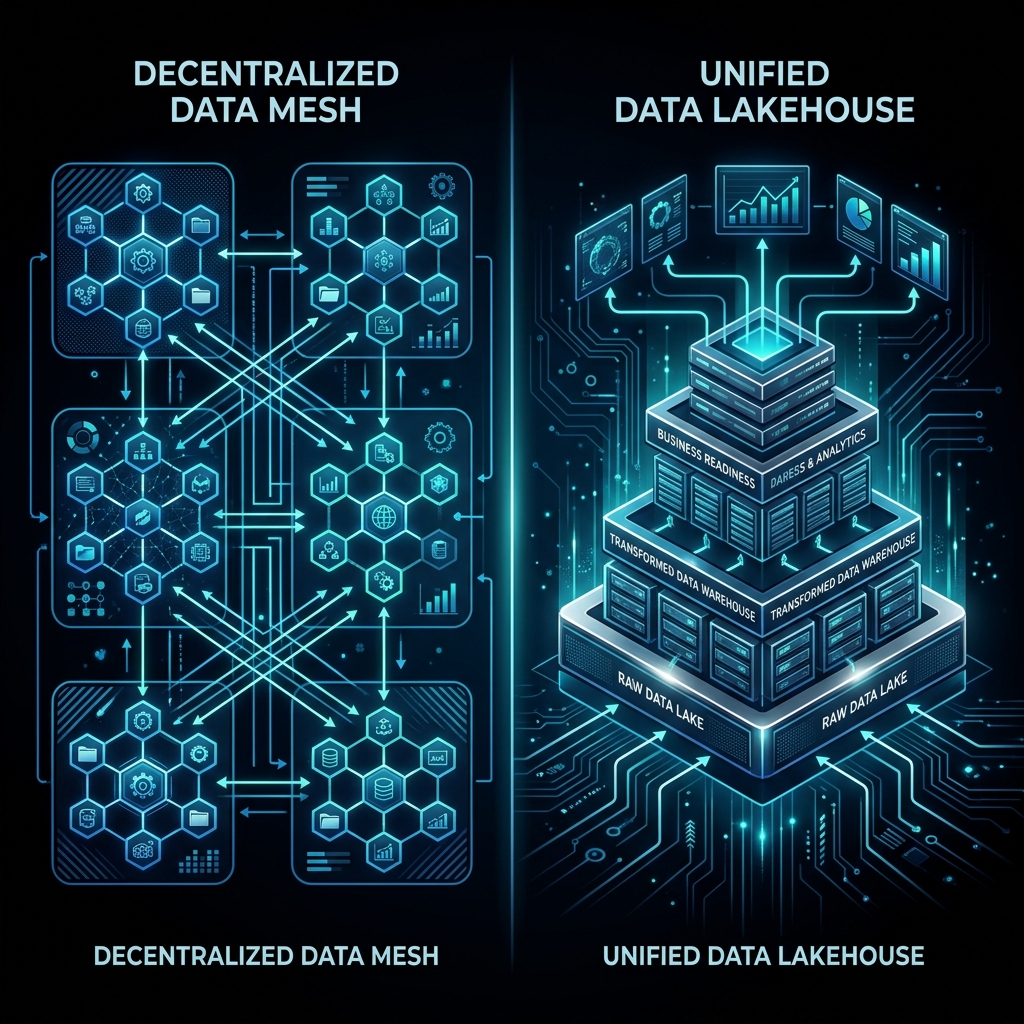
The Future of Enterprise Data Warehousing: Mesh vs. Lakehouse
An analytical deep dive comparing decentralized Data Mesh paradigms with centralized Unified Data Lakehouses, outlining key trade-offs for scaling teams.

Deploying Generative AI Safely Behind Enterprise Firewalls
A complete structural blueprint for deploying private large language models and vector search databases without exposing confidential IP.

Modern Lakehouse Architectures for Enterprise Scale
An architectural analysis of modern Lakehouse deployments, data product design, governance frameworks, and scalability considerations for global organizations.