
Healthcare
We help healthcare organizations modernize their data estate—connecting clinical, operational, and financial data into governed platforms that enable predictive analytics, care coordination, and measurable improvements in patient outcomes and resource utilization.
We help healthcare organizations modernize their data estate—connecting clinical, operational, and financial data into governed platforms that enable predictive analytics, care coordination, and measurable improvements in patient outcomes and resource utilization.
Key Industry Challenges
Fragmented Healthcare Data Systems
Clinical, operational, and financial data live in disconnected systems, preventing a unified view of patient journeys and organizational performance.
Patient Data Fragmentation
Patient records scattered across EHR systems, imaging platforms, and billing databases with no unified view.
Legacy System Interoperability
Incompatible legacy clinical systems cannot share data, creating information gaps at the point of care.
Unoptimized Resource Allocation
Bed occupancy, nurse scheduling, and OR utilization managed manually, leading to inefficiencies.
Population Health Gaps
Inability to proactively identify at-risk patient populations before expensive acute interventions are required.
Revenue Cycle Leakage
Coding errors, claim denials, and billing inefficiencies negatively impact health system performance.
Healthcare Data Modernization Framework
Clinical Analytics Platform
Unified clinical data warehouse connecting EHR, lab, imaging, and claims data for comprehensive patient intelligence.
Patient 360
Longitudinal patient profiles aggregating all touchpoints across the care continuum into a single actionable view.
Revenue Cycle Intelligence
Automated denial prediction, coding accuracy monitoring, and AR aging analysis improving revenue cycle performance.
Healthcare AI
Production AI models for clinical decision support, diagnostic assistance, and patient risk stratification.
Healthcare Workflow Automation
Automated care coordination workflows, capacity planning alerts, and operational reporting across facilities.
Population Health Management
Risk stratification models identifying high-risk patient cohorts enabling proactive, preventive care interventions.
Recommended Modernization Roadmap
Predictive Bed Allocation
Using historical patient records and seasonal ML models to predict emergency admissions, optimizing scheduling.
Clinical Insight from Unstructured Records
Applying NLP to extract disease patterns and care trends from millions of unstructured clinical notes.
Strategy Consultation
Modernize Your Healthcare Strategy
Connect with our principal architects for a technical discovery session tailored to your industry.
Key Takeaways
Improved emergency department throughput through predictive capacity planning.
Unified clinical and operational visibility across care facilities.
Improved treatment outcome tracking across patient demographics.
Explore More
Related Research & Insights
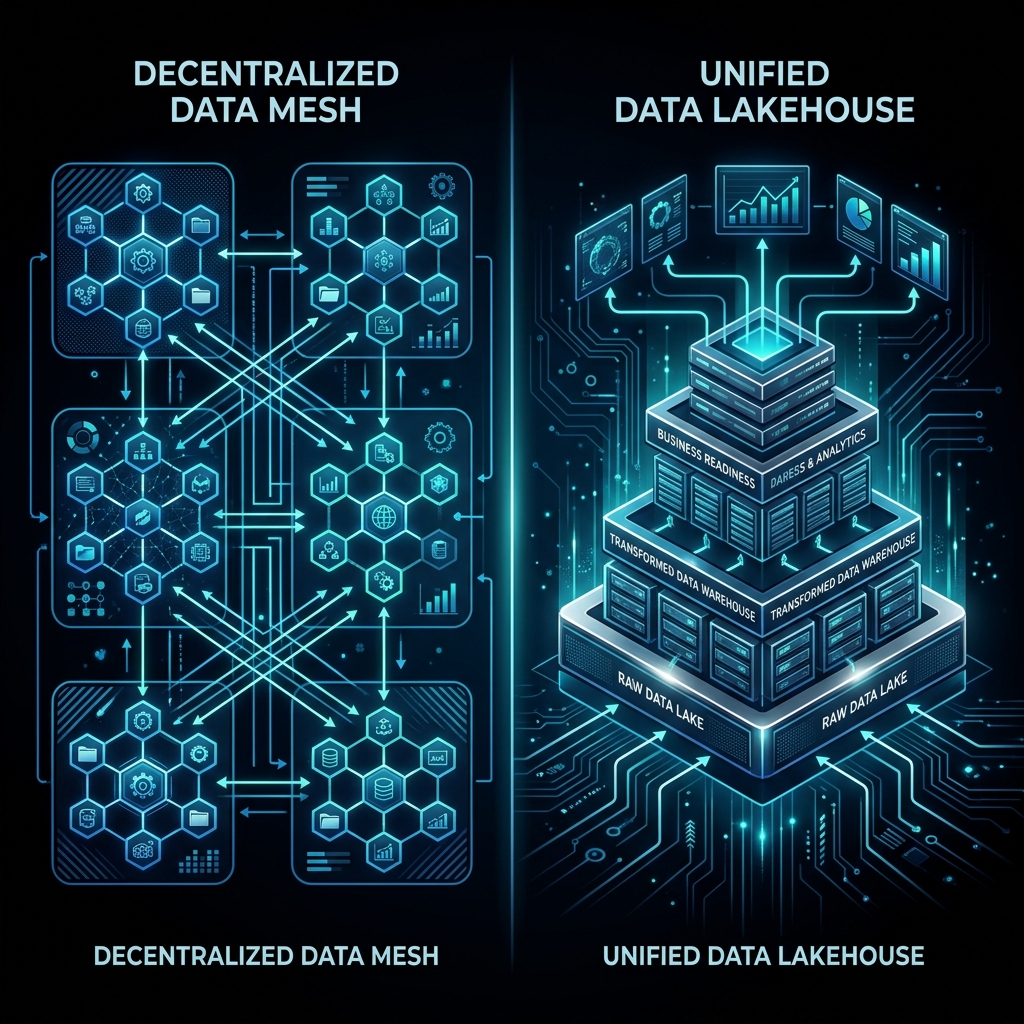
The Future of Enterprise Data Warehousing: Mesh vs. Lakehouse
An analytical deep dive comparing decentralized Data Mesh paradigms with centralized Unified Data Lakehouses, outlining key trade-offs for scaling teams.

Data Governance Strategies for Highly Regulated Industries
How healthcare, finance, and public‑sector organizations establish compliance‑ready data ecosystems while enabling innovation.

Private Enterprise AI: Security, Compliance & Scale
An in‑depth review of governance models, secure deployment patterns, and operational controls for enterprise AI initiatives.