

Private Enterprise AI: Security, Compliance & Scale
An in‑depth review of governance models, secure deployment patterns, and operational controls for enterprise AI initiatives.
An in‑depth review of governance models, secure deployment patterns, and operational controls for enterprise AI initiatives.
Core Concepts
Private Enterprise AI: Security, Compliance & Scale
Threat Model
- Model Exfiltration – Unauthorized access to proprietary weights.
- Prompt Injection – Malicious inputs causing unsafe model behavior.
- Data Leakage – Training data containing PII or confidential IP.
Defensive Architecture
- 1Isolated Compute – Host LLM containers in a VPC with no internet egress; use SG rules to whitelist internal services.
- 2Model Encryption at Rest – Cloud‑KMS‑managed keys protect model artifacts.
- 3Secure Inference API – Authenticated, rate‑limited endpoint; input sanitization middleware.
- 4Audit Logging – Record request payloads, responses, and user identity to immutable storage.
Compliance Controls
- Data Subject Rights – Request hooks that delete user‑provided prompts from logs.
- Security Testing – Regular penetration testing of the inference surface.
- AI‑Specific Guidance – Maintain model cards documenting training data provenance and bias assessments.
Scaling Strategies
- Horizontal Autoscaling – Kubernetes HPA based on GPU utilization.
- Chunked Inference – Split long prompts into manageable windows to keep latency < 500 ms.
- Caching – Store frequently requested completions for identical prompts (subject to privacy constraints).
Operational Playbook
- Change Management – New model versions deployed via canary rollout; monitor drift metrics.
- Incident Response – Automated alerts on abnormal request patterns; immediate isolation of affected pods.
- Continuous Monitoring – Use Prometheus/Grafana dashboards for GPU health, request latency, and error rates.
By combining strict network isolation, policy‑driven governance, and observability, enterprises can safely harness powerful LLMs at scale while meeting regulatory obligations.
Strategic Outlook
Organizations that treat data as a product consistently outperform those that treat it as a byproduct.
— DataParametrics Research Practice
Architecture Comparison
| Feature | Centralized | Decentralized | Hybrid |
|---|---|---|---|
| Governance | Unified | Domain | Federated |
| Scalability | Moderate | High | High |
| Cost Control | Low | Complex | Balanced |
| Latency | Low | Variable | Low |
| Compliance | Simple | Distributed | Policy-as-code |
Core Principles
Privacy by Design
Compliance built into architecture, not added post-launch.
Performance First
Sub-second query engines with elastic auto-scaling clusters.
Data Sovereignty
Full control over data residency, access, and retention.
Discovery Audit
Inventory all databases, classify workloads, and map existing pipelines.
Architecture Design
Define schema standards, network topology, and governance policies.
Engineering Build
Develop secure pipelines, deploy infrastructure, integrate controls.
Quality Verification
Run automated data quality checks and performance benchmarks.
Production Release
Cut-over with zero downtime, monitor, and decommission legacy systems.
Strategic Recommendation
For mid-market enterprises, a hybrid architectural approach consistently delivers the highest ROI within the first 18 months of deployment.
Combine a physical data lakehouse backbone with domain-driven governance boundaries. Standardize metric definitions in a semantic layer to ensure alignment across all business units.
Key Takeaways
Treat data as a product with clear ownership boundaries and quality SLAs.
Combine physical lakehouse storage with domain-driven governance for optimal results.
Privacy engineering must be embedded at the architecture layer, not retrofitted.
Automate compliance monitoring with policy-as-code to reduce manual overhead.
Use a semantic layer to standardize metric definitions across all business units.
Continue Reading
Related Research
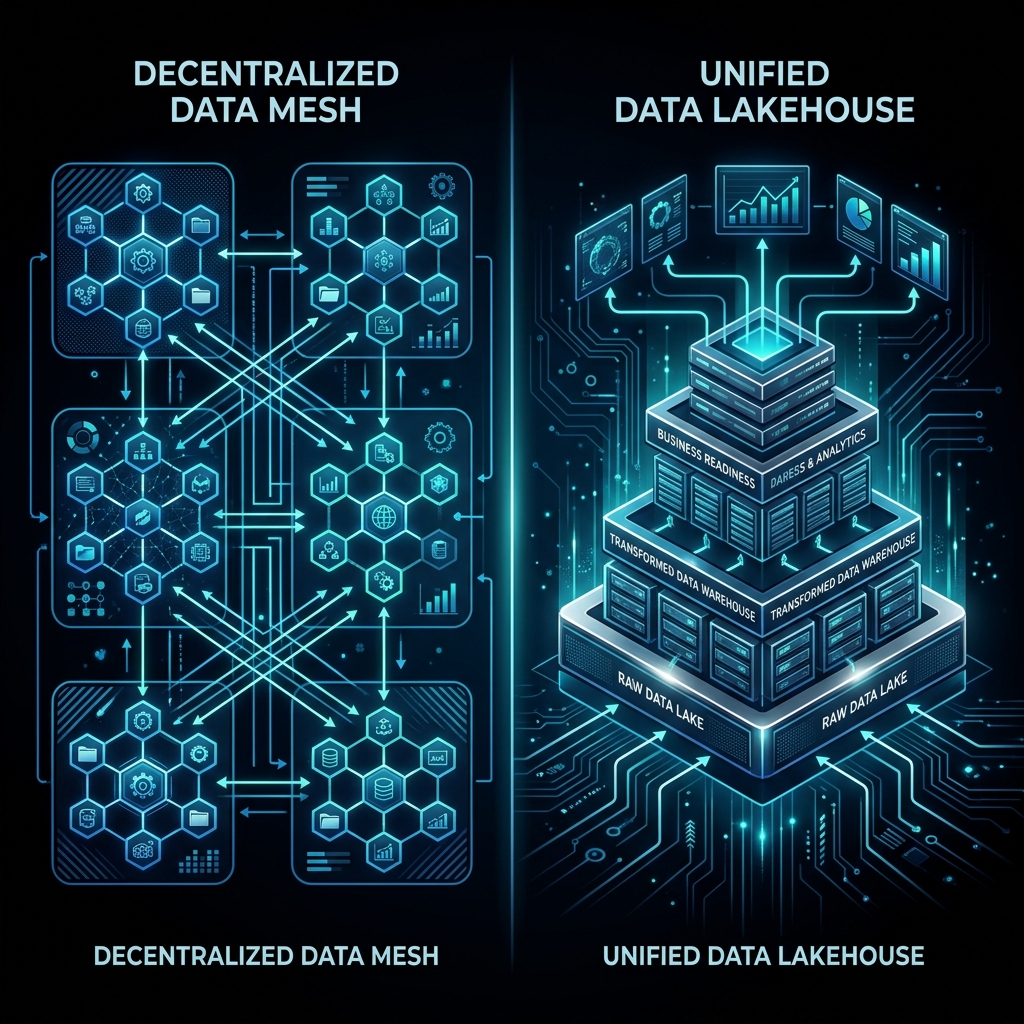
The Future of Enterprise Data Warehousing: Mesh vs. Lakehouse
An analytical deep dive comparing decentralized Data Mesh paradigms with centralized Unified Data Lakehouses, outlining key trade-offs for scaling teams.

Deploying Generative AI Safely Behind Enterprise Firewalls
A complete structural blueprint for deploying private large language models and vector search databases without exposing confidential IP.

Privacy-First Analytics: Engineering for Modern Data Protection
How modern analytics teams can capture customer usage trends and product metrics while maintaining strict compliance with evolving privacy rules.