

Data Governance Strategies for Highly Regulated Industries
How healthcare, finance, and public‑sector organizations establish compliance‑ready data ecosystems while enabling innovation.
How healthcare, finance, and public‑sector organizations establish compliance‑ready data ecosystems while enabling innovation.
Core Concepts
Data Governance Strategies for Highly Regulated Industries
Regulatory Landscape
- Healthcare – Clinical data protection and secure health information handling.
- Finance – Financial data governance and audit-ready reporting.
- Cross-Border – Multi-jurisdiction privacy and data residency requirements.
Core Pillars
- 1Data Catalog & Lineage – Automatic tracking of data provenance across pipelines using metadata catalog tools.
- 2Policy Enforcement – Declarative policies applied via policy‑as‑code frameworks.
- 3Access Management – Fine‑grained RBAC and attribute‑based access control (ABAC) integrated with identity providers.
- 4Audit & Reporting – Immutable logs stored in WORM storage; periodic compliance reports generated automatically.
Implementation Blueprint
- Ingest Layer: Validate schema and tag sensitive fields on entry.
- Transformation Layer: Use dbt to enforce business rules and generate data contracts.
- Storage Layer: Separate raw, curated, and restricted zones; encrypt restricted zone with customer‑managed keys.
- Analytics Layer: Row‑level security in BI tools to hide sensitive data from unauthorized users.
Best Practices
- Zero‑Trust Architecture: No implicit trust between services; every request authenticated.
- Data Minimization: Store only necessary attributes; purge obsolete data after retention windows.
- Continuous Monitoring: Automated scans for policy violations, anomalous access patterns, and data drift.
Outcome
- Reduced audit overhead.
- Faster incident response.
- Demonstrable compliance to regulators and customers.
Strategic Outlook
Organizations that treat data as a product consistently outperform those that treat it as a byproduct.
— DataParametrics Research Practice
Architecture Comparison
| Feature | Centralized | Decentralized | Hybrid |
|---|---|---|---|
| Governance | Unified | Domain | Federated |
| Scalability | Moderate | High | High |
| Cost Control | Low | Complex | Balanced |
| Latency | Low | Variable | Low |
| Compliance | Simple | Distributed | Policy-as-code |
Core Principles
Privacy by Design
Compliance built into architecture, not added post-launch.
Performance First
Sub-second query engines with elastic auto-scaling clusters.
Data Sovereignty
Full control over data residency, access, and retention.
Discovery Audit
Inventory all databases, classify workloads, and map existing pipelines.
Architecture Design
Define schema standards, network topology, and governance policies.
Engineering Build
Develop secure pipelines, deploy infrastructure, integrate controls.
Quality Verification
Run automated data quality checks and performance benchmarks.
Production Release
Cut-over with zero downtime, monitor, and decommission legacy systems.
Strategic Recommendation
For mid-market enterprises, a hybrid architectural approach consistently delivers the highest ROI within the first 18 months of deployment.
Combine a physical data lakehouse backbone with domain-driven governance boundaries. Standardize metric definitions in a semantic layer to ensure alignment across all business units.
Key Takeaways
Treat data as a product with clear ownership boundaries and quality SLAs.
Combine physical lakehouse storage with domain-driven governance for optimal results.
Privacy engineering must be embedded at the architecture layer, not retrofitted.
Automate compliance monitoring with policy-as-code to reduce manual overhead.
Use a semantic layer to standardize metric definitions across all business units.
Continue Reading
Related Research
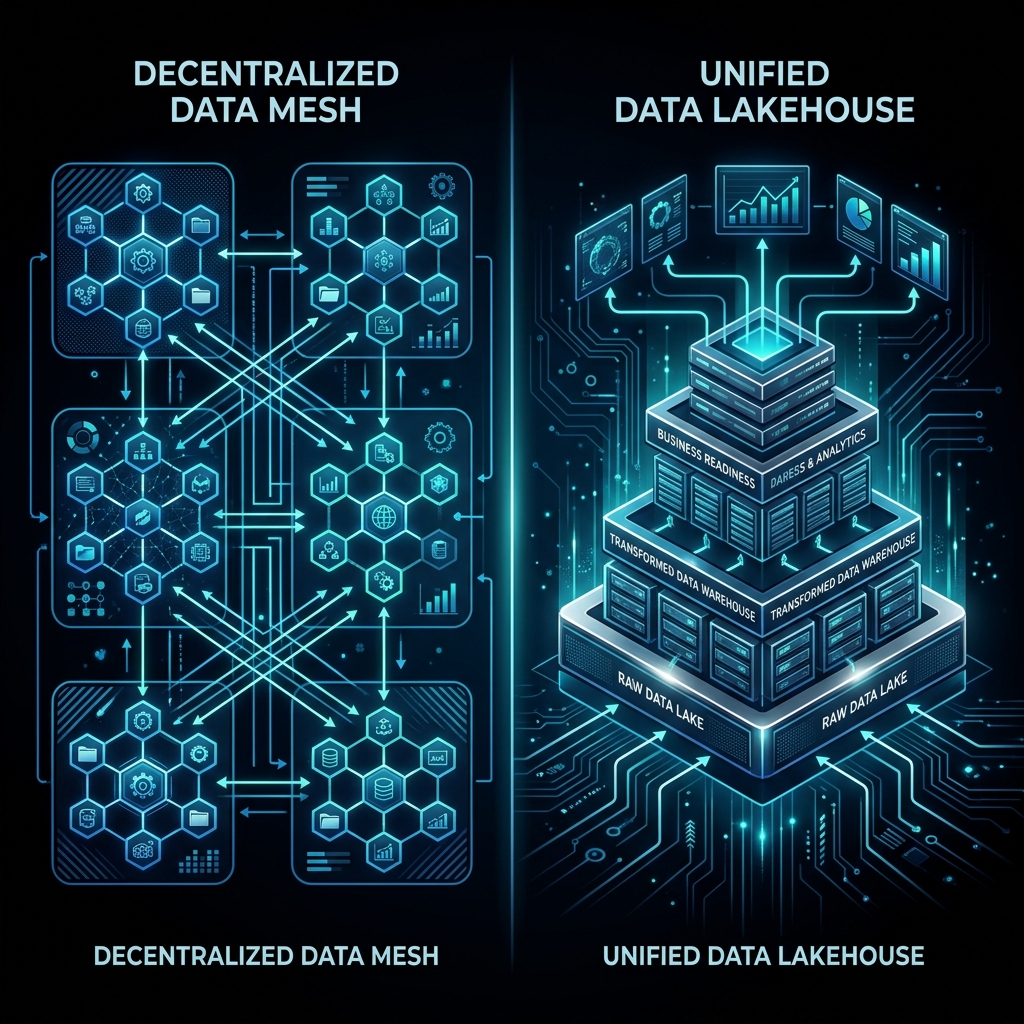
The Future of Enterprise Data Warehousing: Mesh vs. Lakehouse
An analytical deep dive comparing decentralized Data Mesh paradigms with centralized Unified Data Lakehouses, outlining key trade-offs for scaling teams.

Deploying Generative AI Safely Behind Enterprise Firewalls
A complete structural blueprint for deploying private large language models and vector search databases without exposing confidential IP.

Privacy-First Analytics: Engineering for Modern Data Protection
How modern analytics teams can capture customer usage trends and product metrics while maintaining strict compliance with evolving privacy rules.