
Migrating Legacy Data Platforms to Cloud‑Native Architectures
A roadmap for modernizing enterprise infrastructure using scalable cloud data platforms and automation frameworks.
A roadmap for modernizing enterprise infrastructure using scalable cloud data platforms and automation frameworks.
Core Concepts
Migrating Legacy Data Platforms to Cloud‑Native Architectures
Why Migrate?
- Reduce operational debt.
- Enable elastic scaling.
- Leverage managed services for security and compliance.
Migration Phases
- 1Assessment – Inventory all databases, estimate size, and classify workloads (OLTP vs. OLAP).
- 2Schema Modernization – Convert legacy schemas to modern cloud warehouse structures; adopt columnar storage.
- 3Data Transfer – Use high‑throughput pipelines with change‑data‑capture for near‑zero downtime.
- 4Refactoring – Decouple application logic from on‑prem DBs; move to serverless query layers.
- 5Validation – Run data quality checks (Great Expectations) and performance benchmarks before cut‑over.
- 6Cut‑over & Decommission – Switch traffic via DNS failover, monitor, then retire legacy hardware.
Cloud‑Native Best Practices
- Infrastructure as Code: Terraform modules for networking, storage, and IAM.
- Security: VPC private endpoints, encryption‑at‑rest, IAM roles with least privilege.
- Observability: Centralized logging and metrics for latency, error rates.
- Cost Governance: Tag resources, set budgets, and use auto‑scaling to avoid over‑provisioning.
Risks & Mitigations
- Data Loss – Perform checksum validation after each batch.
- Downtime – Use blue‑green deployment and traffic shadowing.
- Skill Gaps – Provide training on cloud data warehouses and managed services.
Successfully migrating positions the enterprise for rapid innovation, advanced analytics, and reduced total cost of ownership.
Strategic Outlook
Organizations that treat data as a product consistently outperform those that treat it as a byproduct.
— DataParametrics Research Practice
Architecture Comparison
| Feature | Centralized | Decentralized | Hybrid |
|---|---|---|---|
| Governance | Unified | Domain | Federated |
| Scalability | Moderate | High | High |
| Cost Control | Low | Complex | Balanced |
| Latency | Low | Variable | Low |
| Compliance | Simple | Distributed | Policy-as-code |
Core Principles
Privacy by Design
Compliance built into architecture, not added post-launch.
Performance First
Sub-second query engines with elastic auto-scaling clusters.
Data Sovereignty
Full control over data residency, access, and retention.
Discovery Audit
Inventory all databases, classify workloads, and map existing pipelines.
Architecture Design
Define schema standards, network topology, and governance policies.
Engineering Build
Develop secure pipelines, deploy infrastructure, integrate controls.
Quality Verification
Run automated data quality checks and performance benchmarks.
Production Release
Cut-over with zero downtime, monitor, and decommission legacy systems.
Strategic Recommendation
For mid-market enterprises, a hybrid architectural approach consistently delivers the highest ROI within the first 18 months of deployment.
Combine a physical data lakehouse backbone with domain-driven governance boundaries. Standardize metric definitions in a semantic layer to ensure alignment across all business units.
Key Takeaways
Treat data as a product with clear ownership boundaries and quality SLAs.
Combine physical lakehouse storage with domain-driven governance for optimal results.
Privacy engineering must be embedded at the architecture layer, not retrofitted.
Automate compliance monitoring with policy-as-code to reduce manual overhead.
Use a semantic layer to standardize metric definitions across all business units.
Continue Reading
Related Research
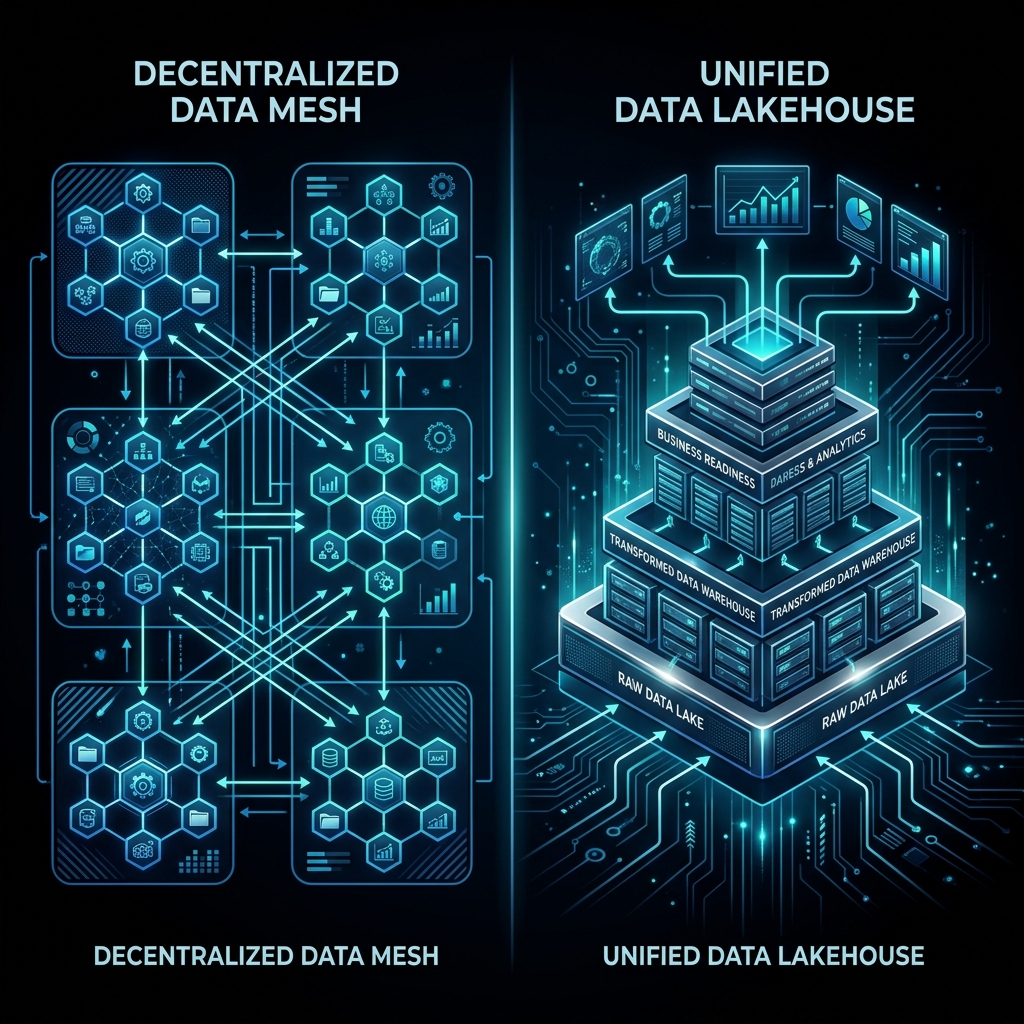
The Future of Enterprise Data Warehousing: Mesh vs. Lakehouse
An analytical deep dive comparing decentralized Data Mesh paradigms with centralized Unified Data Lakehouses, outlining key trade-offs for scaling teams.

Deploying Generative AI Safely Behind Enterprise Firewalls
A complete structural blueprint for deploying private large language models and vector search databases without exposing confidential IP.

Privacy-First Analytics: Engineering for Modern Data Protection
How modern analytics teams can capture customer usage trends and product metrics while maintaining strict compliance with evolving privacy rules.